The Automation Readiness Trap: Why Your Solopreneur Service Business Fails at AI Implementation Before You Even Start
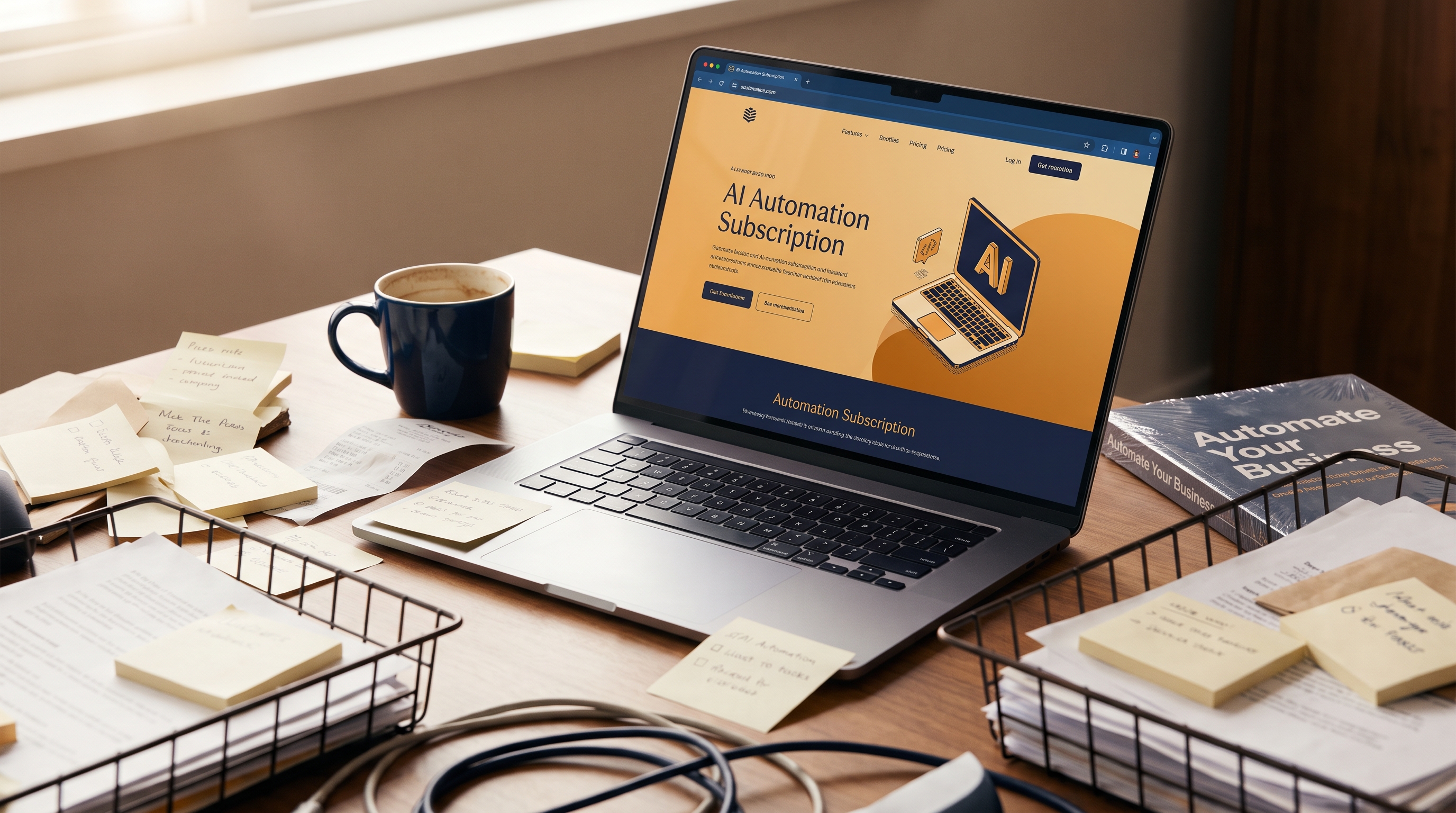
MIT research tracking more than 300 enterprise AI deployments found that roughly 95% of generative AI pilots delivered no measurable profit-and-loss impact. The finding that gets buried in every summary of that research is the explanation: the failures were not caused by weak models. They were caused by organizations that were not ready to absorb what they bought.
For solopreneurs and small service businesses, the number lands differently. Enterprise companies absorb failed pilots. They write off the spend, reassign the team, and move on. You cannot. A $2,000 automation project that produces nothing is not a learning experience. It is a month of revenue gone.
Understanding why AI automation fails in solopreneur service businesses comes down to one pattern I see repeatedly. The business owner shows up wanting to automate before the business is actually automatable. Not because they are unsophisticated. Because nobody told them what automation actually requires before you touch the tools.
That is the readiness trap. And it has nothing to do with which platform you choose.
The Trap Itself: Why "Starting" Is the Wrong First Move
Most solopreneurs approach AI implementation the same way they approach a new productivity app. They identify a painful task, find a tool that promises to handle it, and start configuring. Fast Company noted this pattern directly: many solopreneurs want to prove a task is worth handing over to AI, so they skip straight to prompting and reviewing the result.
The problem is that AI automation is not a productivity app. It is an operating system layer. It touches your data, your process logic, and your decision rules. If any of those three inputs are broken, incomplete, or undocumented, the automation fails. Not eventually. Immediately.
The Cloudera and Harvard Business Review survey of more than 1,500 enterprise IT leaders found that only 7% say their data is completely ready for AI. If that is the number for organizations with dedicated data teams, imagine what it looks like for a one-person consulting practice running on a mix of spreadsheets, a CRM they half-configured two years ago, and a notes app.
Here is the brutal truth: most solopreneur service businesses are not ready to automate anything meaningful. That is not a permanent condition. But it is the current one, and ignoring it is expensive.
The Three Preconditions That Actually Determine Success
Before any automation tool touches your business, three conditions need to exist. Most readiness frameworks are built for enterprise. This one is built for service businesses run by one or two people.
Precondition 1: Data Cleanliness
Automation consumes data. It reads from your CRM, your inbox, your intake forms, your invoicing system. If that data is inconsistent, scattered, or incomplete, every automated output inherits those flaws.
Gartner found that 63% of organizations either lack or are unsure whether they have the right data management practices for AI. For solopreneurs, the number is almost certainly higher, because data hygiene is invisible work that generates no immediate revenue.
The symptoms of a data cleanliness problem are specific:
- Client records exist in three places and none of them match
- Intake information lives in email threads, not a structured form
- Your invoicing history uses different naming conventions across different years
- You have no single source of truth for what a client has purchased, at what price, or when
When you automate on top of dirty data, you do not get clean automation. You get automated errors at scale. The AI does not know your data is wrong. It trusts it and acts on it. That is worse than the manual process you were trying to replace.
The AI Business Toolkit includes frameworks for thinking through your data environment before you touch any automation tool. It is a useful starting point for diagnosing where the gaps are.
Precondition 2: Process Stability
Automation cannot stabilize an unstable process. It can only execute one faster.
A stable process is one that runs the same way every time, with clearly understood inputs and outputs, minimal exception handling, and a consistent sequence of steps. If your process for onboarding a new client changes depending on how the inquiry came in, what type of project it is, what phase your business is in, or how busy you feel that week, it is not stable. It is fluid. And fluid processes cannot be automated.
The IntouchCX analysis put this clearly: a use case can appear well suited for automation while the process behind it tells a different story. Leaders need to understand how work actually happens and where employees rely on judgment or workarounds that formal documentation may not capture.
For solopreneurs, this problem is acute because you are the process. Everything lives in your head. You handle exceptions intuitively without realizing they are exceptions. You have informal rules you apply without being able to name them. When you try to hand that process to an automation system, it breaks immediately because the system cannot read your intuition.
I wrote about this problem in depth previously, and the core issue remains the same: before you automate, you need to know what you are actually automating. If you cannot describe your process in writing, step by step, with every conditional handled, the automation is not ready. You are.
The questions that diagnose process stability:
- Could you train someone to do this task in two hours using only written instructions?
- Does this process ever require you to make a judgment call that you cannot fully explain?
- Has this process changed in the last six months?
- Are there exceptions to the normal flow that happen more than 10% of the time?
If you answer no to the first question and yes to any of the remaining three, the process is not stable enough to automate yet.
Precondition 3: Decision Rule Documentation
This is the precondition that almost no one talks about and nearly everyone skips.
Every business process contains decision points. When a lead comes in, do you qualify them or respond immediately? When a project scope changes, how do you calculate the additional fee? When a client is overdue, at what point do you escalate versus give them another week?
These decision rules govern how your business actually operates. They are the logic layer underneath the visible process. And in a solopreneur service business, they exist almost entirely as tacit knowledge in your head.
Automation requires explicit rules. Not general guidelines. Not "it depends." Specific conditions and specific outcomes. If X is true, do Y. If A and B are both true, do C unless D is also true, in which case escalate.
If you cannot write your decision rules down with that level of specificity, the automation will either fail or require constant manual intervention to handle all the cases you did not anticipate. Which means it is not really automated. It is just a different kind of manual.
To get a preliminary read on where your business stands across all three preconditions, the free AI ROI Calculator can help you quantify the potential value at stake before you spend anything on implementation.
Why the Readiness Gap Is More Expensive Than It Looks
The obvious cost of a failed automation is the tool subscription you cancel and the hours you wasted configuring something that did not work. That number is real but small.
The hidden cost is the six months you spent believing automation was your growth lever, while the actual constraint (your data, your process, your decision documentation) went unaddressed. That is where the real damage happens.
The AI services trap compounds this. As the Mind the Gap analysis noted, AI can handle most of a workflow while humans manage the exceptions. For solopreneurs, that sounds like the goal. But if you never fix the underlying preconditions, you end up with a business that is superficially automated but operationally fragile. Growth creates new workflows. New workflows create new exceptions. And the exceptions keep requiring you.
The AI Automation Playbook covers the frameworks for thinking about which workflows are actually ready for automation versus which ones need process work first. It is the right resource if you want to understand the structural logic before you engage any tool.
The Self-Assessment That Solopreneurs Skip
An honest readiness assessment takes about two hours. Most solopreneurs skip it because it feels like a delay. It is not. As one readiness framework noted, four weeks spent measuring readiness routinely saves six months of budget spent on the wrong perimeter.
For a solopreneur, the equivalent math is simpler. One afternoon of honest process documentation prevents a $1,500 failed pilot.
The three questions that cut to the center of it:
On data: Can you pull a complete, accurate client list with full purchase history in under five minutes from a single system? If the answer is no, your data is not ready.
On process: Pick the process you want to automate first. Write it out, step by step, in under 30 minutes. If you cannot, or if the written version looks nothing like what actually happens, the process is not ready.
On decision rules: For every judgment call in that process, write the rule that governs your decision. If you find yourself writing "it depends" more than twice, your decision rules are not documented enough to automate.
These are not trick questions. They are diagnostic ones. The answers tell you whether you need to automate, or whether you need to do the upstream work that makes automation possible.
If you want a structured starting point, the free Starter Pack includes templates for mapping your existing processes before you touch any automation tool. It is designed specifically for service-based solopreneurs working through this kind of pre-automation groundwork.
What Readiness Actually Unlocks
When all three preconditions are in place, automation delivers. Not because the tools are better, but because the inputs the tools depend on are finally trustworthy.
A business with clean data, stable processes, and documented decision rules can automate client onboarding in a week. The same business without those preconditions spends three months configuring and reconfiguring and eventually abandons the project.
The difference is not technical sophistication. It is whether the business has done the unglamorous preparatory work that AI tools assume you have already done.
The data readiness research from 2026 is direct on this: the dividing line is not model access. It is data readiness. The businesses that fix their foundation first are the ones that scale.
For service solopreneurs, "foundation" means three things. Clean data. Stable processes. Documented decision rules. In that order.
If you have read this and realized your business has gaps in one or more of these preconditions, the AI Snapshot is built for exactly this situation. It is a focused audit of your current state across all three readiness dimensions, with a prioritized roadmap delivered in 48 hours. You walk away knowing precisely what needs to happen before you spend a dollar on implementation. That is the right order of operations.
Related articles

The Repetitive Task Invisibility Problem: Why Solo Consultants Underestimate Admin Work Until They Track It
Solo consultants routinely undercount how many hours disappear into admin work. Here is why context-switching hides the true cost, and what it is actually costing you.

The AI Agent Confidence Trap: Why Your Solo Service Business Gets Plausible Wrong Answers Instead of Admissions of Uncertainty
Your AI agent is not confused when it gives wrong answers. It is doing exactly what it was designed to do. Here is why that is a problem your business cannot afford to ignore.

The Automation Readiness Misconception: Why 73% of SMBs Think They're Ready for AI When Their Workflows Still Live in Email Chains
Most SMBs confuse buying AI tools with being ready for AI. Here is the diagnostic framework that reveals the gap between perceived readiness and actual process maturity.
Explore more from MapleLine
Want to go deeper?
Get the full playbook with 25+ ready-to-use systems, templates, and frameworks.
Explore the Guide →