The Automation Readiness Misconception: Why 73% of SMBs Think They're Ready for AI When Their Workflows Still Live in Email Chains

You Bought the Tools. You Are Not Ready.
A business automation readiness assessment is supposed to happen before you buy software. Most SMBs skip it entirely. They subscribe to an automation platform, connect a few apps, and call themselves AI-ready. Then they wonder why nothing actually works.
Here is the data that should make you pause. According to research from Clutch, 73% of organizations regularly use AI across their operations. Yet only 10% describe it as core to how they actually run the business. Zapier's survey of over 500 SMB owners found that 76% have adopted some form of automation. But that adoption ranges from simple rule-based triggers to AI making decisions across multiple systems. The gap between those two ends of the spectrum is enormous, and most SMBs dramatically overestimate where they fall on it.
The underlying problem is not the tools. It is the workflows those tools are supposed to automate.
The Readiness Illusion
When I audit a small business that says it is ready for AI automation, I ask one question before anything else: can you show me the written process for your five most common workflows?
Most owners go quiet. Then they describe the process verbally, fluently, with confidence. They know how it works. The problem is that it exists entirely in their head, in scattered email threads, and in the informal knowledge of whoever has been doing the task longest.
According to Slaterock Automation, over 60% of small businesses cite undocumented workflows as their primary barrier to successful automation. That number matches what I see in practice. The majority of SMBs attempting automation are trying to automate processes they have never formally written down.
This creates what I call the readiness illusion. The business owner has used the workflow a thousand times. It feels documented because they understand it. But understanding a process and having it in a form that software can follow are two completely different things.
Why Email Chains Are the Symptom, Not the Problem
Email is where undocumented workflows go to hide. When your onboarding process lives in a thread between you and three clients from six months ago, when your approval flow is whoever replies fastest, when your exception handling is a forwarded message with "thoughts?" in the subject line, you do not have a workflow. You have a series of human judgment calls that happen to produce consistent outputs most of the time.
AI cannot operate on most of the time. It needs explicit rules, defined paths, documented exceptions, and clear escalation logic. As one recent analysis from Beginefusion put it directly: automated workflows require explicit rules detailing standard paths, exception branches, and escalation authorities. An AI agent cannot divine which source is true when your policies, your client records, and your actual practice all conflict with each other.
Email chains are proof that your process is undocumented. They are the paper trail of ad hoc decisions masquerading as repeatable operations.
The Four Layers of Process Documentation Maturity
When I assess whether an SMB is genuinely ready for automation, I look at four layers. Most businesses max out at layer two.
Layer 1: Awareness. The business owner can describe what happens. The process exists somewhere in human memory. Nothing is written. This is where most email-chain businesses live.
Layer 2: Tribal documentation. Some steps are written down, usually after something went wrong. SOPs exist but are incomplete, outdated, or known only to specific people. The process breaks immediately when that person is unavailable.
Layer 3: Operational documentation. The full process is mapped, including exceptions. Anyone on the team can follow it. Handoffs are explicit. This is the minimum viable starting point for automation.
Layer 4: Process legibility. The documentation is structured in a way that software can actually interpret. Inputs, outputs, conditions, and triggers are explicit. Exception branches are defined. This is where real automation begins.
Most SMBs trying to implement AI automation are at layer one or two. They are attempting to automate a process that is not yet legible to software, and often not fully legible to their own team.
The AI Business Toolkit includes a process maturity framework that helps you quickly identify which layer your core workflows are actually at, before you commit to any automation investment.
The Hidden Cost of Starting at the Wrong Layer
This is where the financial reality gets uncomfortable. Businesses that skip the readiness assessment do not just waste the cost of the software subscription. They waste implementation time, staff attention, and often months of troubleshooting before realizing the tool was never the problem.
Want to see what that actually costs your business? The free AI ROI Calculator lets you estimate the real cost of delayed or failed automation against the potential savings of getting it right the first time.
The math is not complicated. If your invoicing process takes four hours a week and you spend three months trying to automate it incorrectly, you have not saved any time. You have added meeting time, vendor calls, troubleshooting sessions, and the cognitive load of managing a broken system alongside your manual backup process.
Research from MIT found that roughly 95% of generative AI pilots delivered no measurable profit-and-loss impact. The reason is almost always the same: the data and process foundation was not ready before the tool was deployed. AI does not fix broken processes. It makes broken processes move faster, which makes the underlying problem more visible and more painful.
Three Symptoms That Reveal Your Process Is Not Automation-Ready
You do not need a formal audit to start diagnosing this. These three symptoms appear consistently in businesses where automation is going to fail before it starts.
Symptom 1: Your process description changes depending on who you ask. If you and your office manager describe your client intake process differently, the process is not documented. It is a shared improvisation. Automation requires one consistent version of the truth.
Symptom 2: Your exceptions outnumber your standard cases. Every workflow has exceptions. But if you find yourself saying "it depends" more than three times while describing a single process, that process is not ready to be automated. The exceptions need to be mapped and handled explicitly before software touches any of it.
Symptom 3: The process requires someone to "check in" or "use judgment" without criteria. This is the clearest signal. If the next step in your workflow is "Sarah looks it over and decides," you do not have a defined step. You have a human decision point with no documented logic. AI cannot replicate undocumented judgment. If you want to understand why that specific problem is so expensive, I wrote about it in depth in a recent post on the judgment work trap.
The Tool Adoption Trap
There is a specific pattern I see constantly. An SMB owner reads about AI automation, signs up for a platform, and starts connecting tools together. It feels productive. The dashboard looks impressive. Then they try to automate their first real workflow and hit a wall.
The wall is always the same: the workflow cannot be built because no one can fully define it. The automations that do get built handle the happy path fine. The moment an exception appears, the system breaks and someone has to intervene manually. The business ends up maintaining both the automated system and the manual fallback, which is more work than doing it manually from the start.
This is what the research from ASBN describes: businesses with established, functioning processes are better positioned to layer AI onto existing workflows. The keyword is established. Not assumed. Not tribal. Documented, tested, and consistent.
If you want a structured starting point before getting into tool selection, the free Starter Pack includes workflow mapping templates I use with clients at the beginning of every engagement. It will not replace a full assessment, but it will show you where your documentation gaps actually are.
What Actual Readiness Looks Like
A business that is genuinely ready for automation can answer these questions without hesitation:
- What triggers this process to start?
- What is the exact output when the process completes?
- What are the three most common exceptions, and how is each one handled?
- Who is responsible for each step, and what happens if they are unavailable?
- Where does the data for this process come from, and is it consistent?
If any of those questions require more than two sentences to answer, the process needs more documentation work before automation is attempted. That is not a failure. It is simply the correct sequence: document first, automate second.
The AI Automation Playbook covers the sequencing framework in detail, including how to identify which processes in your business are worth documenting for automation versus which ones should stay manual.
The Diagnostic Question Every SMB Should Ask
Before spending another dollar on AI tools, ask yourself this: if I had to hand this process to a contractor who has never met me, with no verbal explanation, could I give them a written document that gets the job done correctly 95% of the time?
If the answer is no, you are not ready to automate it. You are ready to document it.
That documentation work is where the real preparation for a business automation readiness assessment happens. It is not glamorous. It does not make for impressive screenshots. But it is the difference between automation that delivers results and automation that creates a new category of problem to manage.
The 73% of businesses using AI who have not made it core to operations are not failing because the technology is bad. They are failing because they skipped this step.
If your workflows still live in email threads and tribal knowledge, and you want an honest picture of where your business actually stands before you invest further, the AI Snapshot gives you a personalized readiness diagnosis in 48 hours. No fluff. Just a clear assessment of what is documented, what is not, and what to fix before automation can work for your specific business.
Related articles

The Repetitive Task Invisibility Problem: Why Solo Consultants Underestimate Admin Work Until They Track It
Solo consultants routinely undercount how many hours disappear into admin work. Here is why context-switching hides the true cost, and what it is actually costing you.

The AI Agent Confidence Trap: Why Your Solo Service Business Gets Plausible Wrong Answers Instead of Admissions of Uncertainty
Your AI agent is not confused when it gives wrong answers. It is doing exactly what it was designed to do. Here is why that is a problem your business cannot afford to ignore.
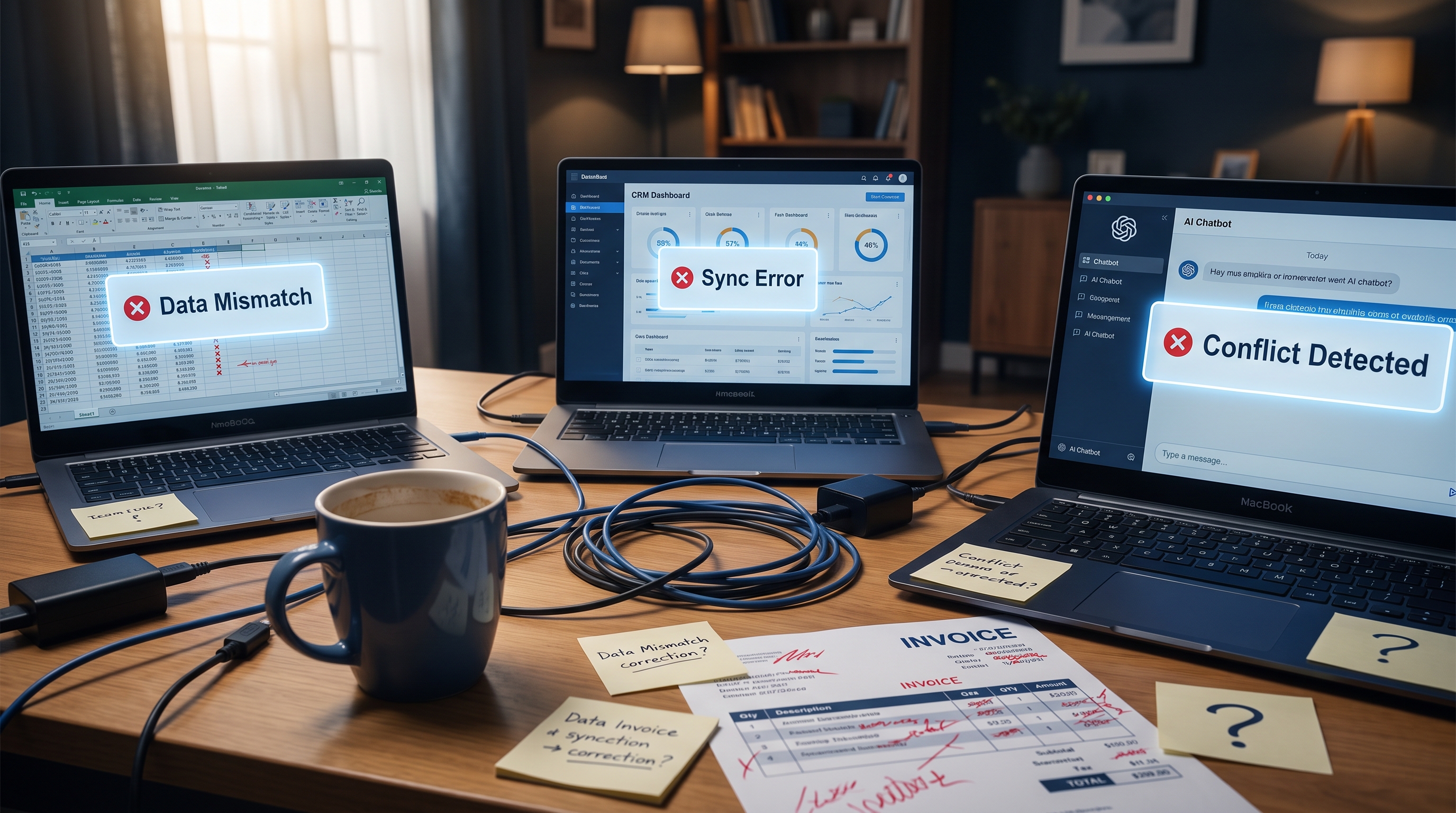
The Integration Graveyard: Why Solo Service Consultants Who Connect AI Tools to QuickBooks End Up Maintaining Two Separate Systems
You connected your AI tools to QuickBooks and your CRM. Now you have three systems instead of one. Here is why AI tool integration failures for solopreneurs happen before the first invoice gets sent.
Explore more from MapleLine
Want to go deeper?
Get the full playbook with 25+ ready-to-use systems, templates, and frameworks.
Explore the Guide →